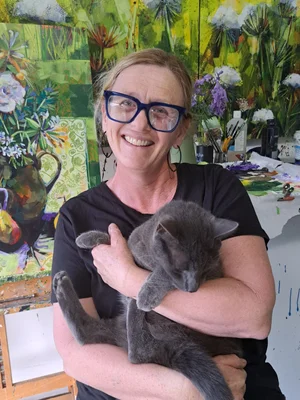
Success, Reconsidered: Reflections On 2025
Success, Reconsidered: What 2025 Taught Me About Art, Worth, and Doing It My Way
What if success isn’t about momentum, money, or milestones, but about understanding yourself well enough to keep going?
We are three weeks into 2026, and it has taken me a while to get going.
This is a reflection on success, art, money, shame, ADHD, and learning, slowly, to stand behind my work.
I was being far too hard on myself after the momentum of 2025 came to a screeching halt at the end of the year. My December blog turned into a bit of a laundry list of everything I had done. In itself, that felt worthwhile, we forget all too quickly what actually happens in a year. But once I’d written it all down, I started thinking about what it meant.
I found myself feeling that 2025 hadn’t been as successful as 2024. I hadn’t sold as much work. I hadn’t made as much money. And that, of course, led me straight into the murky question of what success actually is, and how we measure it.
Selling my art is important to me. And yet I struggle with actually telling people that my work is for sale, that it’s good, worth having, and, dare I say it, worth paying for. I’m fully aware that this is a complete contradiction. I got tired of myself saying, I don’t know what to do, I don’t know how to get people to buy my work, while secretly hoping that someone would come along and either help me… or just do it for me.
The truth is, I can make the work. I’ve arrived at a place where I know what I make is good. That is a giant step forward. For years, I carried a lingering kernel of doubt, worries about getting “ too big for my boots” and being too proud. I know now that this is a remnant of growing up in the North-East of England, in the 1970s, where getting above yourself was considered shameful and unbecoming.
Recognising my talent and trying to lose any shame around that is a success.
Making work to sell vs making work to say something
Throughout 2025, I spent a fair amount of time wondering whether work made to sell has the same worth as work made to fulfil a concept, work that says something. I make work I enjoy making. I make beautiful work. Work that explores colour, value, shape, form, pattern, paint application, and marks. But I struggled to let go of the idea that my art was somehow lesser because it wasn’t overtly conceptual.
I noticed myself becoming defensive in conversations where work generated primarily through theory or intellectual process was being lauded over work developed through making. But I don’t work like that. I develop my ideas through the practical process of making. I work hard and prolifically.
A friend gently pointed out that my defensiveness might be tied to long-held beliefs I hadn’t quite unpacked. My degree was in textiles and fashion, specialising in embroidery. Women who make art using traditional methods have always worked under a cloud of misogyny, with the added insult of being dismissed as craft. I chose embroidery because, to me, it was fine art, just using textile methods. But it was endlessly hard to explain, and I often ended up feeling foolish or defeated.
The irony is that I can’t sew. I can’t make clothes. I hate sewing machines. Looking back, I suspect much of my ineptitude was due to undiagnosed ADHD. I loved my degree, but there is undeniable academic snobbery around arts degrees, and a degree in embroidery seemed, to many, laughable. I am proud of my degree, and yet I know I still carry some shame around it.
I stopped making textiles partly because I no longer wanted to defend my work so vigorously. The craft versus art argument felt tired and jaded, and I was over it.
Which brings me back to this idea of making art to sell versus art as some higher calling.
Whimsy, defence, and learning to take myself seriously.
I’m still wrestling with that. For years, I was deliberately glib about my work as a form of self-protection. I made whimsical work, it was cute, colourful, fun, because it didn’t need explaining. I told myself I wasn’t intellectual enough to have complex concepts; after all, I had a textile degree. I declared that I had nothing to say.
That, of course, was a cover. For crushing introversion. For shame. For fear.
The truth is, I always had ideas. Many of them were sly jokes or social commentary, hidden inside bright colour and whimsy. And as I get older, I’m trying very hard not to give a flying fuck about small-minded people who get a kick out of their own perceived superiority.
One of the biggest successes of 2025 was finally facing my feelings of inadequacy around my practice and my background, and realising, with the help of generous art friends, that my work does have something to say. Being aesthetically and technically well-made is not something to hide, but rather something to celebrate and be proud of.
2025 was also a huge year personally.
A year of change: home, diagnosis, and relief
We moved house, and I know, deeply, that we made the right decision. It’s funny how many people like to tell you what you’ll miss and how hard it will be. I don’t miss it. And it isn’t.
I was diagnosed with ADHD in 2025. That was enormous, and it came with both relief and grief. Relief that all the odd things I do turned out to be coping strategies. Relief that my exhaustion made sense, that masking and surviving for almost 60 years in a world designed for neurotypical brains is genuinely exhausting. And grief for the child who was “too much”, who learned to hide, who felt confused and wrong.
It was hard. But I am profoundly glad I now know. And I’m working through it. The medication I have been prescribed isn’t a magic pill, but it has been life-changing.
The diagnosis has helped my practice too. I can better understand why I work the way I do, and what makes me, well, me. I accept that I am far too hard on myself, which is a classic ADHD trait. Understanding that has helped me step back and be kinder. That alone feels like a huge leap forward.
In July, three weeks before we moved house (excellent timing, not ideal, but completely on brand), I started a business course.
Learning the business of art
(and not throwing my laptop out the window) Without my ADHD diagnosis and medication, I don’t think I could have coped. The learning curve has been steep, but I can now work through technology that would previously have felt utterly impossible. My laptop would almost certainly have been launched through an open window more than once.
The course has given me access to ideas and tools I simply wouldn’t have been able to grasp before. Not because I’m incapable, but because my brain doesn’t work linearly. I’m often uncomfortable, sometimes confused, but I’m moving through modules, learning systems I didn’t even know existed, let alone how to use them. That feels like a huge win. I know that discomfort is a sure sign of growth.
So no, 2025 may not have been a bumper year of sales, exhibitions, or profit.
Redefining success
What I’m carrying forward into 2026 is this: success doesn’t always look loud or lucrative. Sometimes it looks like understanding your own mind. Sometimes it looks like staying in the room. Sometimes it looks like doing the uncomfortable thing, marketing, showing up, saying this work matters, even when you’d rather hide.
I’m still learning. I’m still squirming. But I’m doing it.
And that, I think, counts as success. But it was successful in far more meaningful ways: in understanding how my brain works, in being kinder to myself, and in beginning to take real responsibility for the marketing and selling of my work.
I’ve always said I wanted an agent to do it all for me. And maybe one day that will happen. But I’m starting to see that I can do this myself. There is discomfort and squirm around marketing, content creation, and being seen, figuratively and literally, but I’m doing it.
And that, I think, counts as success.
If you’re reading this and feeling a quiet connection to the way I work, know that my paintings are available to live with. They’re made slowly, with attention, and with a deep love of colour, place, and the everyday beauty around me.
Supporting my work—by collecting a piece, coming to a workshop, or simply sharing it, helps me keep making. And that matters more than I used to let myself believe.